Project detail
Nest Mate
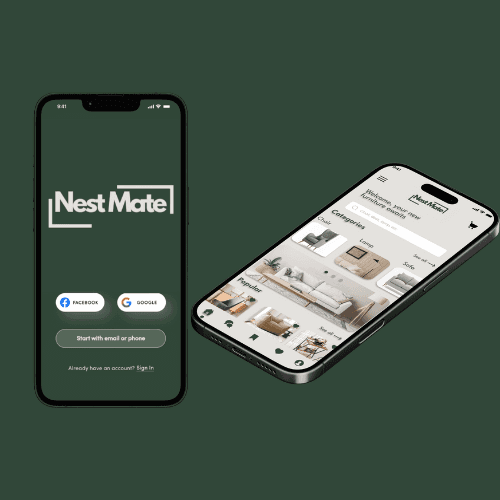
Nest Mate – AR-Powered Furniture Marketplace Nest Mate is an AR-powered furniture marketplace that helps users make confident purchasing decisions by visualizing furniture in their own space.


My Role
I served as a co-lead UX/UI designer, where I was responsible for both design execution and team coordination.
My responsibilities included:
Leading app design from wireframes to high-fidelity prototypes
Designing core user flows and interactions
Developing storyboards to define key AR interactions
Coordinating design direction and team communication
The Problem: An Overwhelming Furniture Market
Buying furniture online often feels overwhelming due to a lack of visualization, personalization, and clarity around sustainability.
Limited visualization — Users struggle to imagine how furniture will look in their space
Lack of personalization — Few tools adapt to individual room sizes and style preferences
Environmental uncertainty — Users aren’t informed about the impact of new vs. secondhand furniture
As a result, users often hesitate, abandon purchases, or regret decisions after buying.
Understanding the User
To ground design decisions in real needs, I focused on a primary user who shops online but hesitates before purchasing furniture.
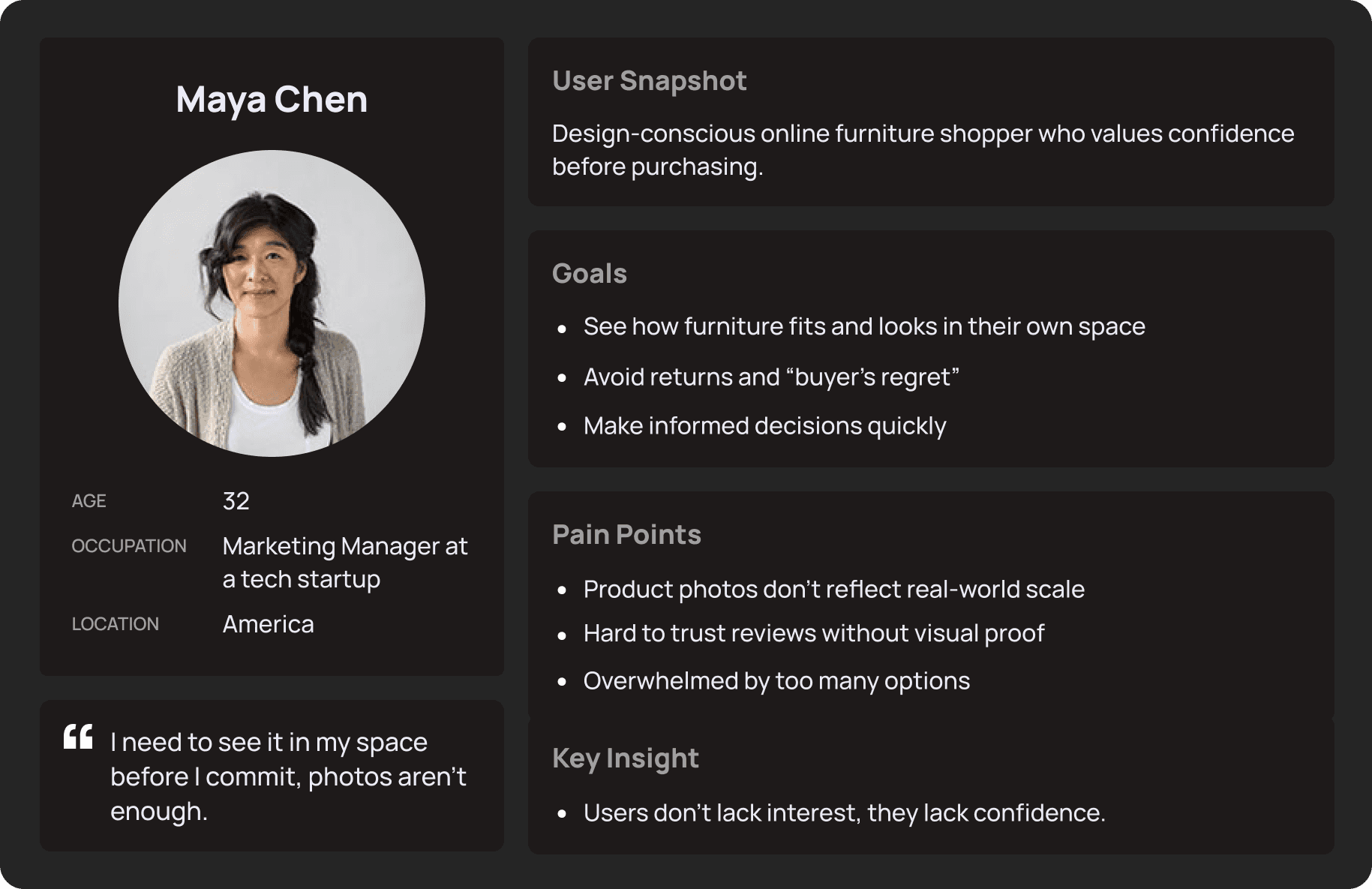
With a clear understanding of the user and their needs, I explored the broader problem space to uncover patterns, constraints, and opportunity areas.
Exploring the Problem Space
To understand the full problem space, I mapped out user pain points and opportunity areas before defining solutions.
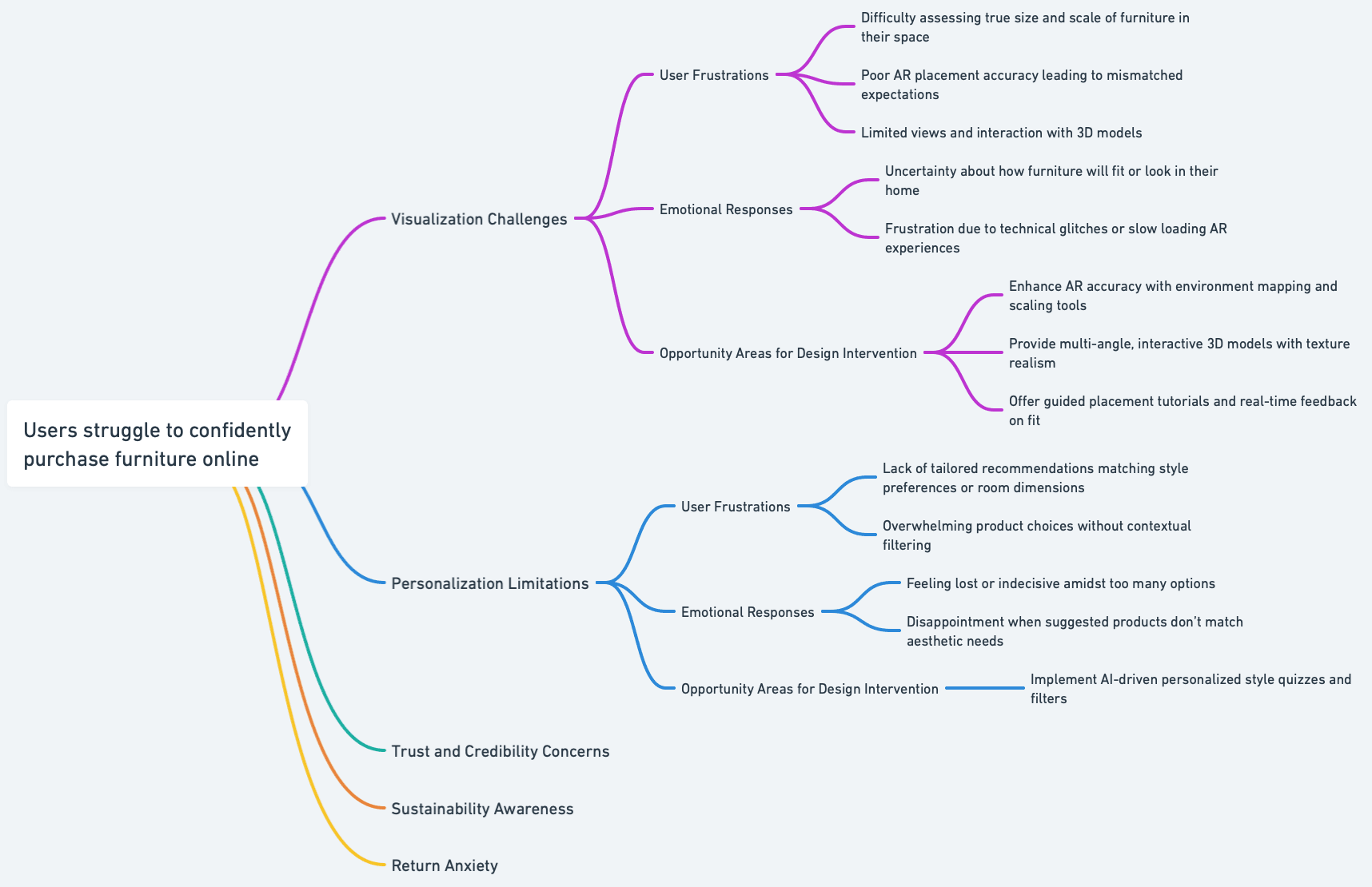
This exploration helped identify confidence, trust, and visualization as the most critical areas to address.
The Key Insight
Users aren’t overwhelmed by furniture options — they hesitate because they can’t confidently predict how furniture will look or fit in their own space. This lack of visual certainty erodes trust and leads to delayed or abandoned purchases, even when interest is high.
The Solution: Nest Mate
Nest Mate addresses this confidence gap by allowing users to preview furniture at true scale in their own space before purchasing.
It combines:
Enable AR room preview to eliminate scale and fit uncertainty
Surface visual social proof at key decision points
Guide interactions to reduce cognitive load and decision fatigue
Core Idea: Design focus shifted from offering more options to reducing uncertainty at key decision moments.
Key Design Decisions
Based on the key insight, we focused on three decisions to reduce uncertainty at key purchase moments.
AR Room Placement
Why this mattered
Users lacked confidence that furniture would fit or look right in their space, leading to hesitation and abandoned purchases.
Design decision
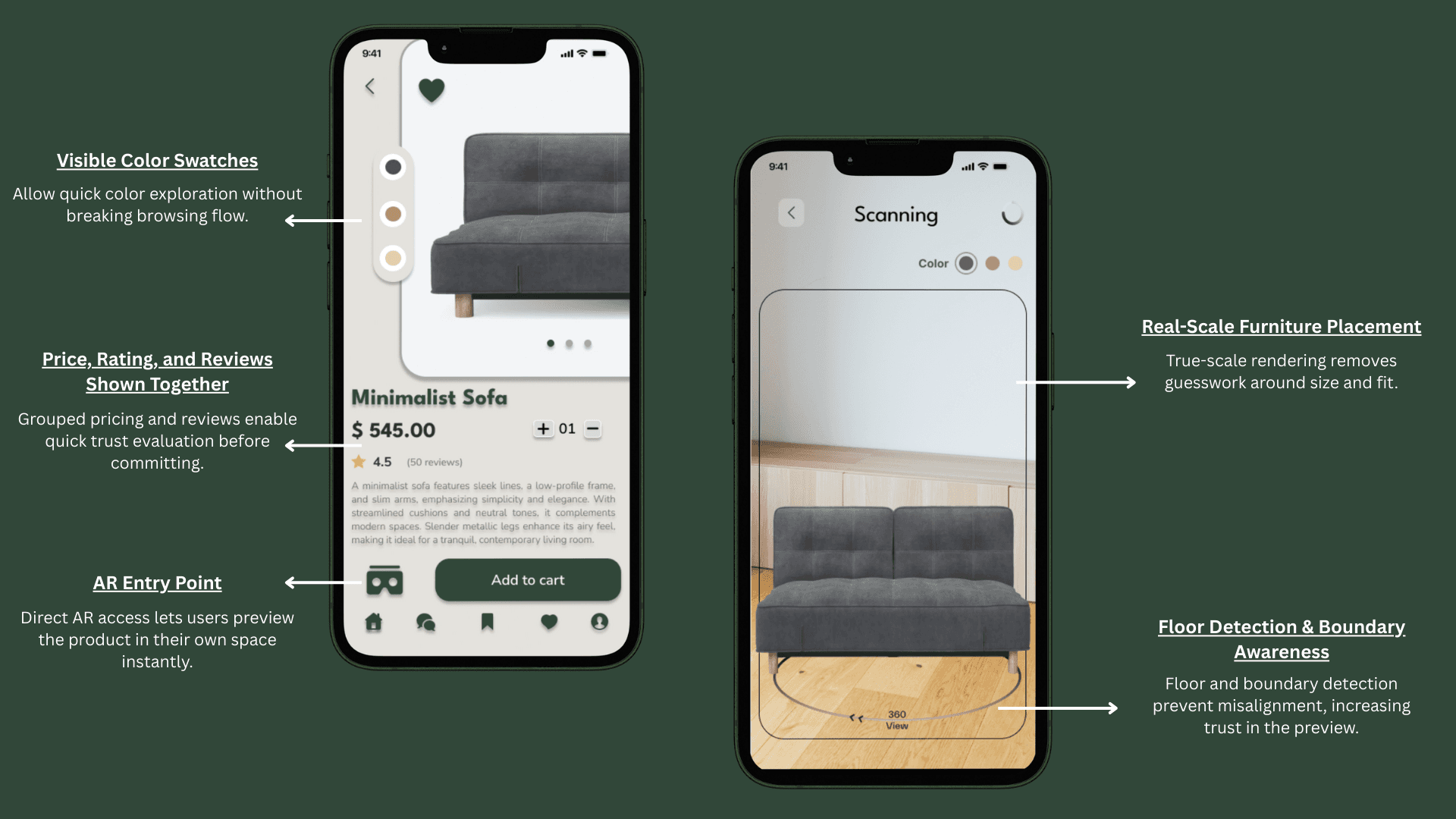
We surfaced AR room placement directly from the product detail experience, allowing users to preview furniture at true scale before committing.
Outcome
By replacing imagination with real-world context, users were able to make faster, more confident purchasing decisions.
Design Process
To translate insights into a usable product, I moved through user flows, wireframes, and high-fidelity UI—validating decisions at each stage.
User Flow
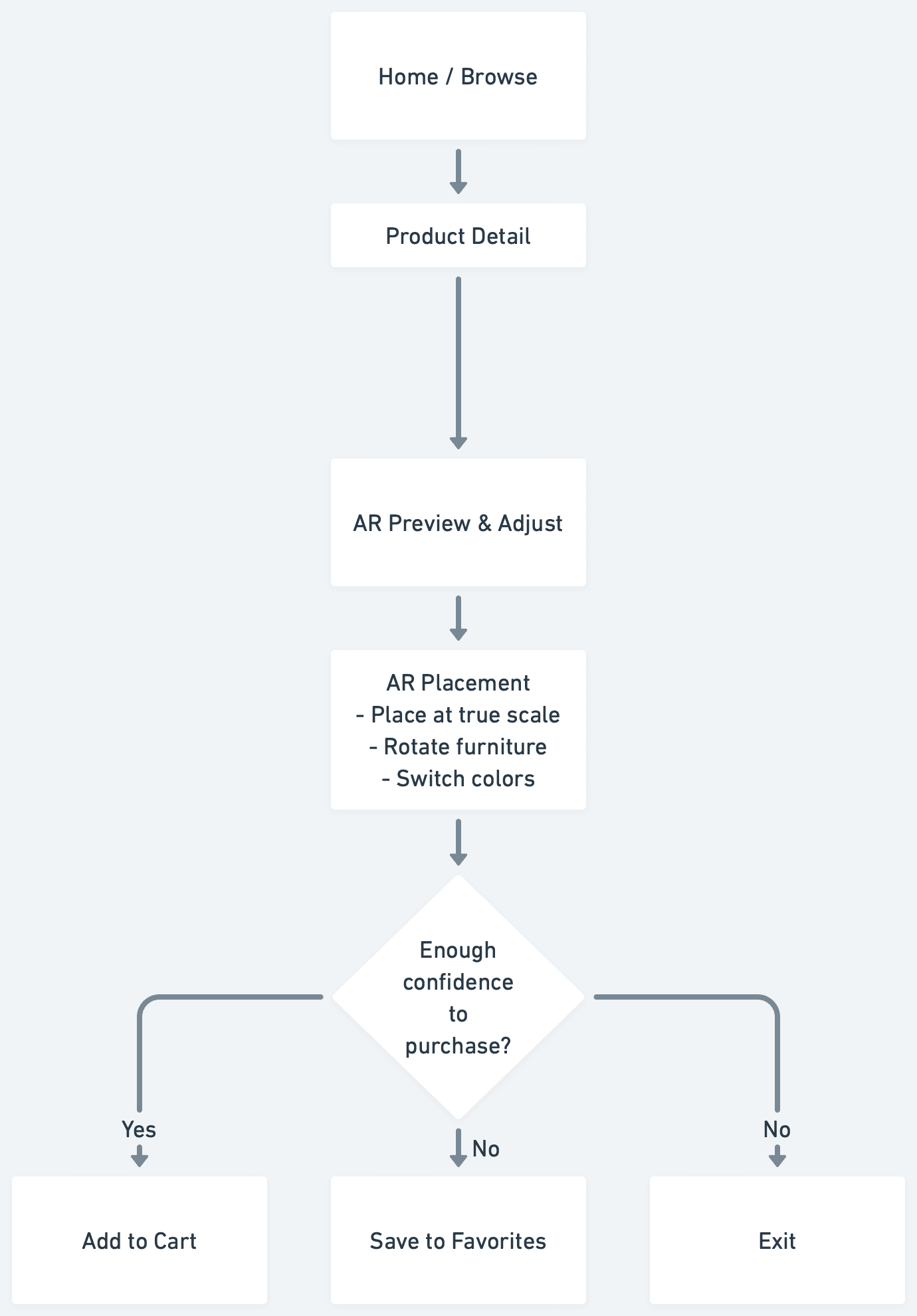
This flow highlights the critical decision point where users gain confidence through AR visualization before committing to a purchase.
Low-Fidelity Wireframes
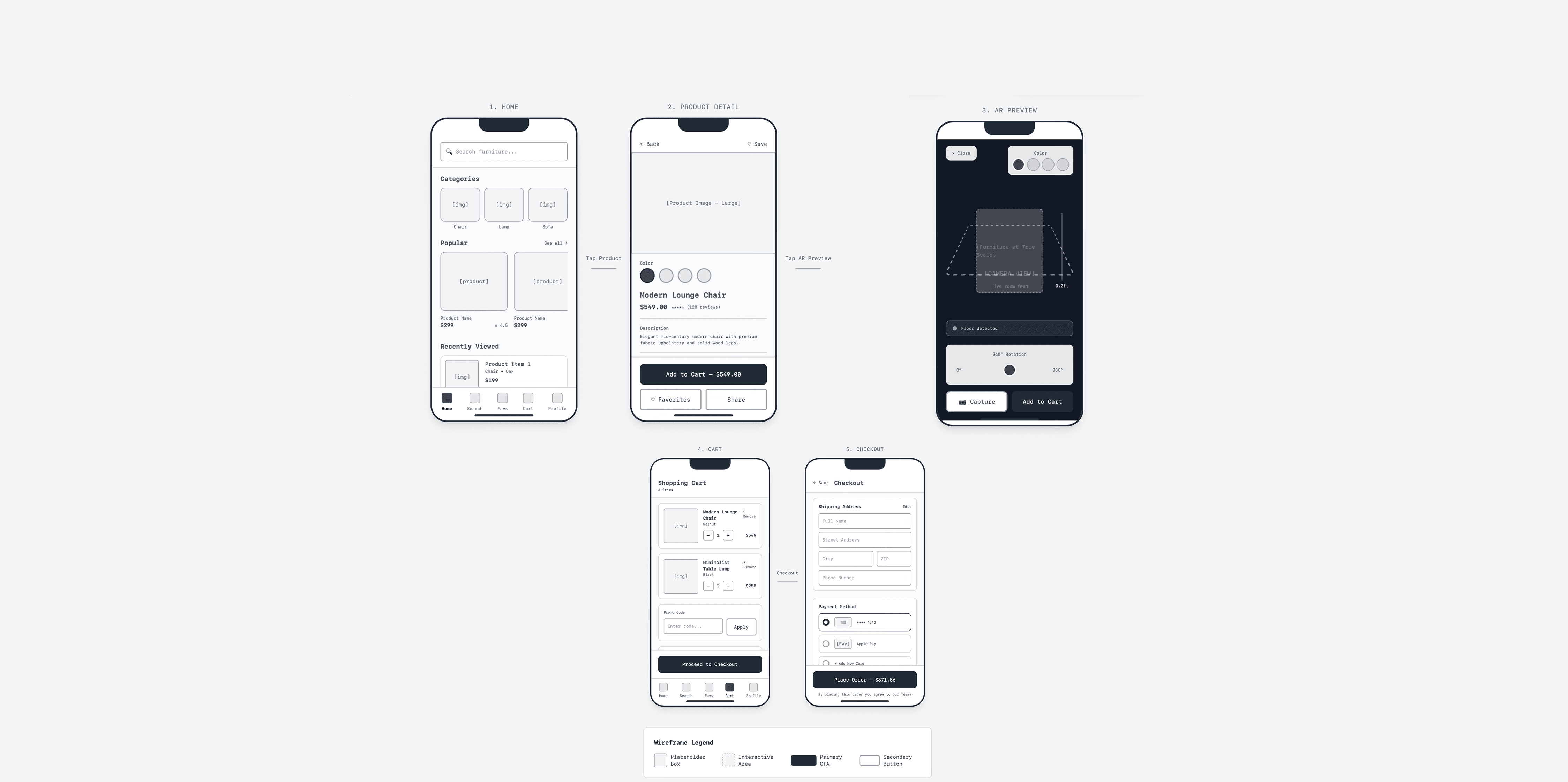
These wireframes validated hierarchy, AR entry points, and the purchase decision flow before committing to high-fidelity design.
High-Fidelity Design
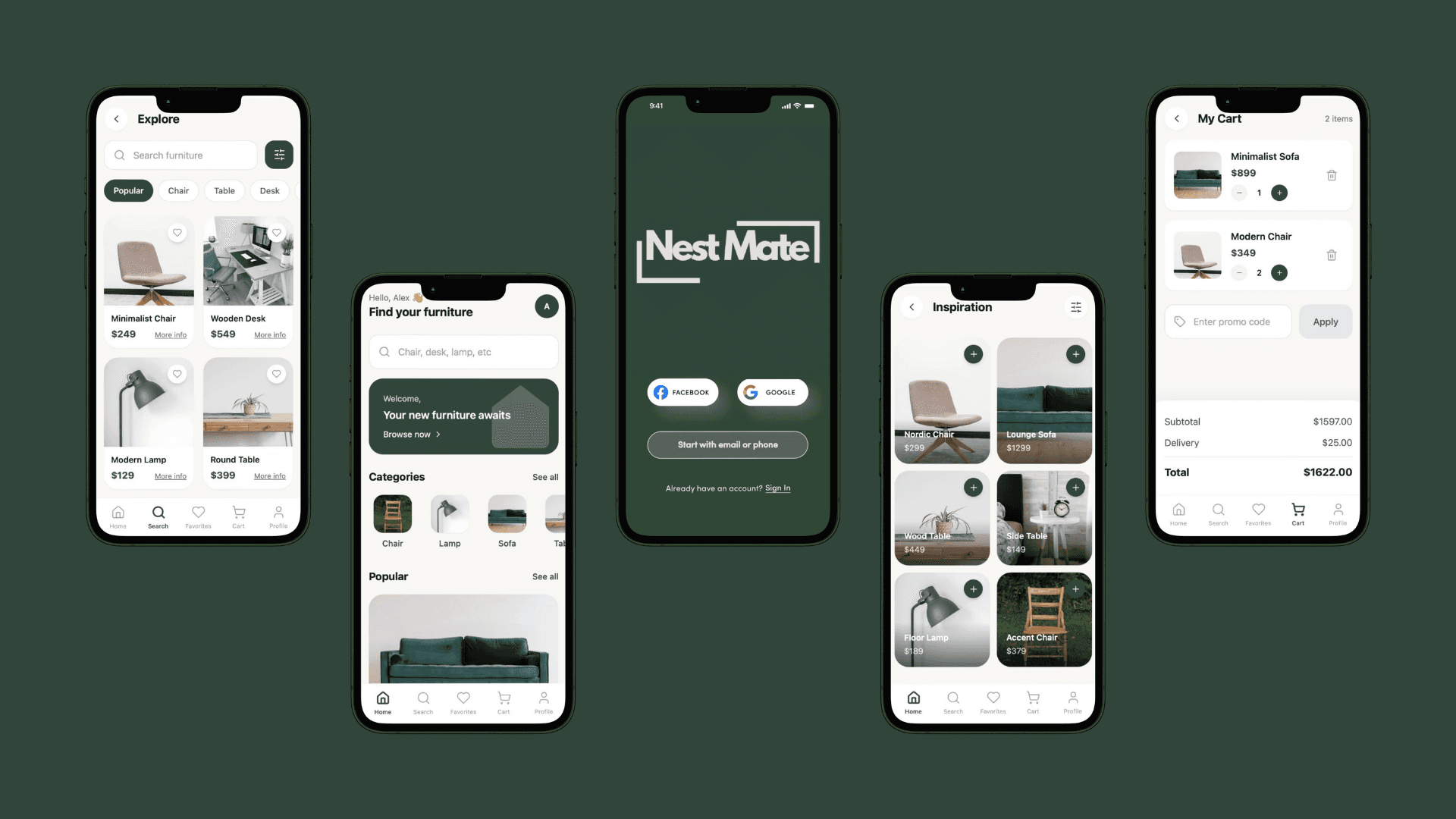
High-fidelity screens focused on reducing uncertainty at key decision moments while maintaining a calm, furniture-first visual system.
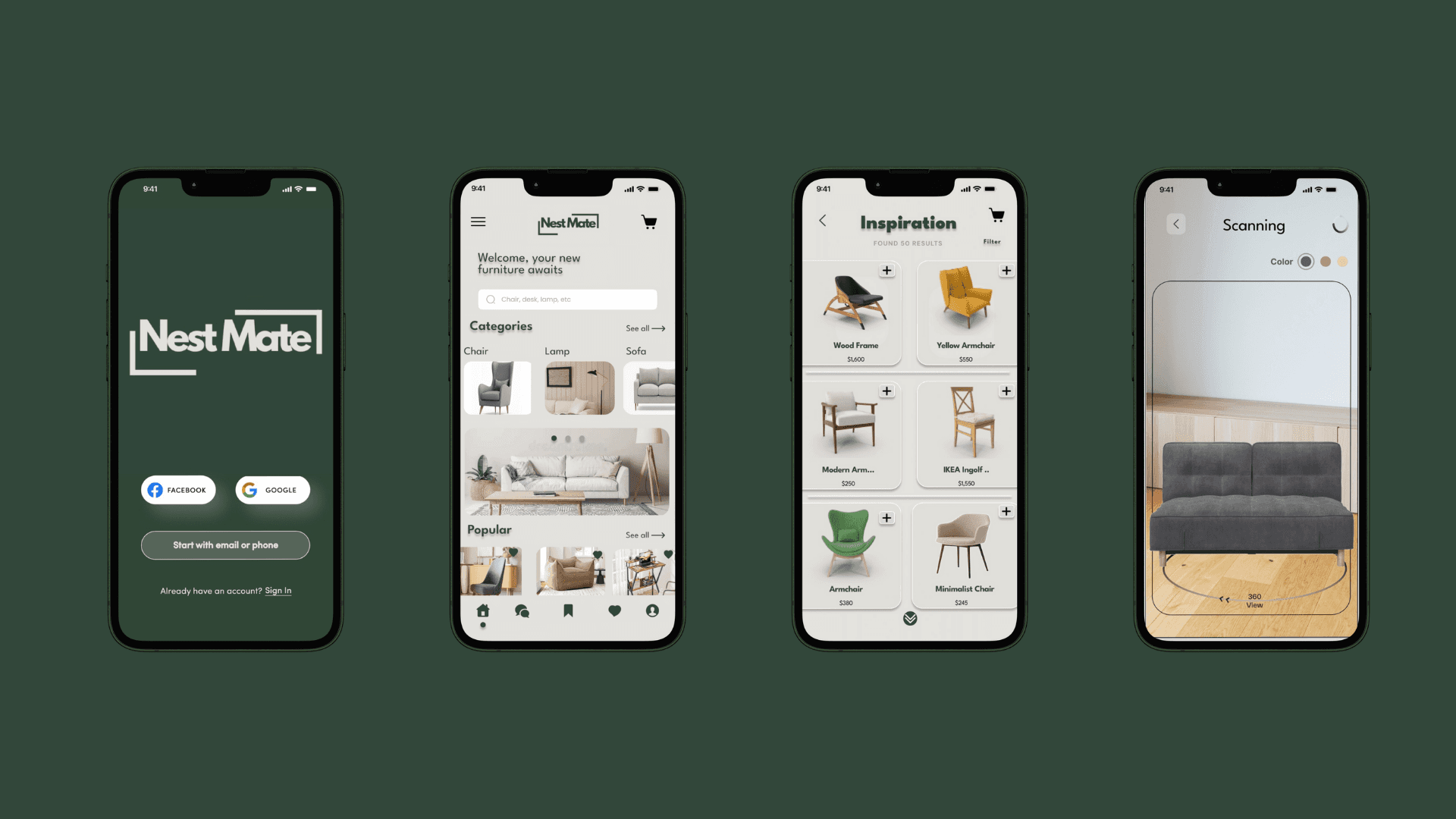
The interface prioritizes early AR access, clear product comparison, and minimal distraction at purchase-critical moments.
Design Direction
The visual system emphasizes calm, furniture-first layouts to reduce cognitive load and keep attention on the product. Neutral backgrounds, restrained color usage, and clear hierarchy help users compare options quickly. AR entry points are intentionally visible but non-intrusive, supporting exploration without disrupting browsing flow.
High-Fidelity Interaction Highlights
Subtle interactions reinforce scale, realism, and confidence at key decision moments.
Color Switching
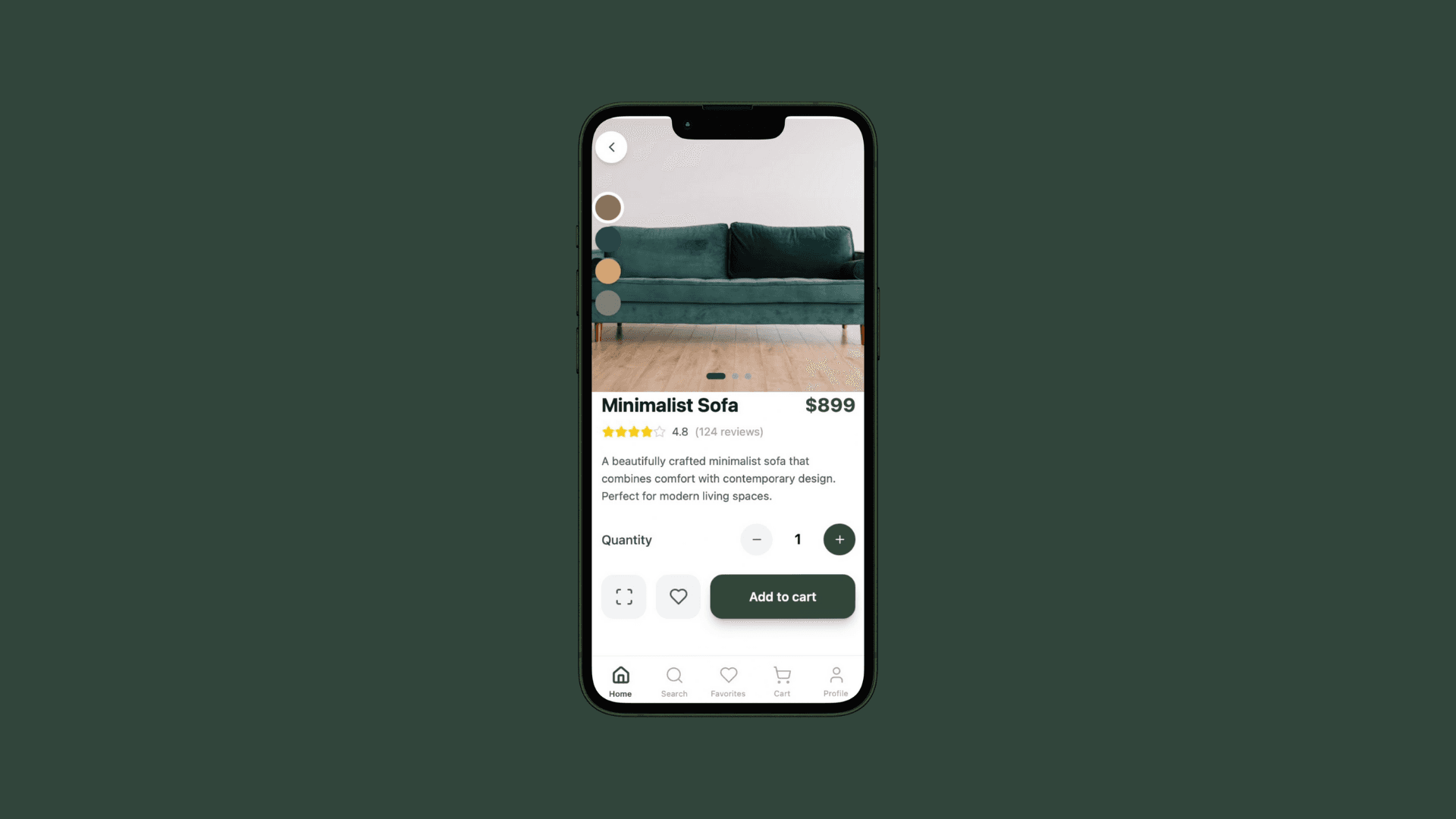
Inline color switching supports fast comparison without breaking browsing flow.
AR Placement

True-scale AR placement allows users to validate size and fit before committing to purchase.
Testing & Iteration
How I tested
I evaluated the flow by walking users through key tasks including browsing furniture, previewing items in AR, switching variations, and deciding whether to purchase. Feedback focused on clarity of AR entry points, confidence in scale, and ease of comparing options without losing context.
What I learned
Users felt most confident when AR preview was available early in the decision process, not just at checkout. Visual confirmation of scale significantly reduced hesitation, while grouped pricing, ratings, and reviews helped users validate decisions faster.
What changed
Based on this feedback, AR access was surfaced directly from the product detail screen, color switching was made inline, and interaction controls were simplified to minimize cognitive load during high-intent moments.
Final Outcome
The final experience transforms furniture shopping from a guessing game into a confidence-driven flow. By enabling true-scale AR visualization, streamlined comparison, and calm decision-making moments, Nest Mate empowers users to move from exploration to purchase with clarity and trust.
Reflection & Learnings
Designing for confidence, not just aesthetics, fundamentally changes how users move through purchase decisions.
If extended, I would explore community-driven AR reviews to further reinforce trust through shared real-world context.
This project reinforced my approach to UX as a balance between emotional reassurance and functional clarity, especially at decision-critical moments.